
Grid-Connected BESS Containers for Substations: Design, Sizing and Value
Power grids worldwide face a new kind of instability. As intermittent renewable energy is connected at scale, networks suffer from power curtailment, voltage fluctuations and frequency swings. Without robust localized stabilization, utilities risk frequent blackouts — and containerized battery energy storage systems (BESS) have emerged as the practical answer.
A grid-tied system charges during off-peak periods and discharges when demand peaks, protecting electrical assets and balancing power distribution. Yet its real value depends on engineering choices: system size, cooling, protection architecture and grid connection decide both performance and lifetime. This article explains what a BESS container is, how to size one, and whether it is worth the investment.
What Is a BESS Container and How Does It Work?
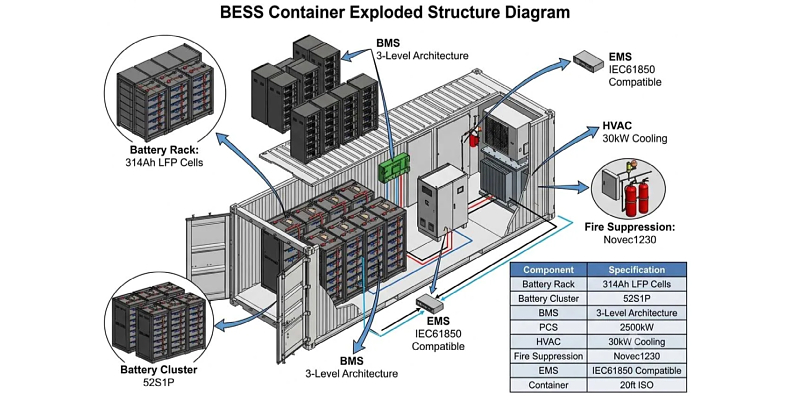
A BESS container is a factory-integrated energy storage enclosure that combines battery racks, a battery management system (BMS), a power conversion system (PCS), HVAC or liquid cooling, fire suppression, auxiliary power and monitoring hardware in one standardized unit — integrated and tested at the factory for rapid deployment and standardized grid connection.
In operation, the system charges its cells through the PCS when power is surplus and discharges through the same path when the grid needs support. Most utility installations use AC coupling, where the PCS converts battery DC to AC near the container; DC coupling, which ties the battery to a shared DC bus, suits some hybrid projects. A typical substation layout runs from battery racks and BMS through the PCS, low-voltage cabinet and transformer to medium-voltage switchgear, then to the grid, with the transformer raising voltage and the switchgear providing isolation, protection and fault clearing. In short, a BESS container at a substation is a coordinated electrical plant, not a simple equipment purchase.
Why Utilities Are Deploying BESS at Substations
Utilities install storage at substations because a battery responds in milliseconds, stabilizes voltage and frequency, and relieves congested feeders — capabilities conventional assets cannot easily match. Value usually comes from stacked services rather than one isolated revenue stream:
Peak shaving — lowering transformer loading at peak demand.
Frequency regulation — fast, precise system balancing.
Renewable integration — absorbing fluctuations and reducing curtailment of solar and wind.
Grid support — maintaining power quality during disturbances and congestion.
Commercially, these services translate into energy shifting, ancillary service revenue and avoided infrastructure spending. The strongest cases appear where congestion, demand charges or renewable variability are already expensive — which is why many developers now choose a prefabricated enclosure instead of a custom civil-built station.
How to Size a BESS for a Utility Project
The right size for a utility BESS is set by the required power in MW, energy in MWh, target discharge duration, service duty cycle and battery C-rate limits — not by choosing the largest enclosure available. Power rating sets how much support the system can deliver at once; energy rating sets how long it can sustain that output. Duration selection often drives economics more than the battery nameplate: a 1 MW/1 MWh system and a 1 MW/4 MWh system solve completely different problems. A higher C-rate improves dispatch flexibility but adds thermal stress and can accelerate degradation.
As a market reference, container systems follow two common footprints (values vary by supplier):
20 ft standard container — around 1.5 MW / 3.0 MWh at roughly 1100-1200 V DC, in 0.5C energy or 1C fast-response versions, usually with integrated liquid cooling, round-trip efficiency of about 88% and a design life of around 6000 cycles at 80% depth of discharge.
40 ft high-density container — around 3.4-3.5 MW / 6.8-7.0 MWh on a 1500 V DC architecture, optimized for peak shaving at 0.5C, with advanced liquid cooling, about 89% round-trip efficiency and 6500+ cycles at 80% depth of discharge.
Sizing should start from the service objective, then move to network constraints. Peak shaving may need only a shorter-duration system, while renewable smoothing and congestion relief require more MWh and a more conservative C-rate. High-capacity classes only fit when transport, foundation load, transformer capacity and fire separation all align. Both footprints commonly use lithium iron phosphate (LFP) chemistry and reference standards such as UL 9540/UL 9540A, NFPA 855, IEC 62933 and IEC 62619. On cooling, liquid cooling usually wins for high-density systems because it keeps cell temperatures uniform and supports higher duty cycles; air cooling works for smaller sites but loses appeal when power density, ambient heat and lifetime matter.
Typical Applications of Containerized Storage
Utility-scale solar farms — energy shifting, ramp-rate control, export optimization.
Wind farms — output smoothing and frequency response.
Utility substations — voltage support, spinning reserve, congestion relief.
Industrial plants — peak demand reduction and backup power.
Large EV charging stations — reducing transformer upgrades, supporting ultra-fast charging.
Remote microgrids — integration with solar, wind and diesel generation.
One containerized system can often serve several of these functions if the control strategy is designed well from the start.
Design Lessons: Thermal Management and Failure Modes
The most common failure modes in substation BESS projects are thermal management faults, PCS faults, HVAC breakdown, transformer overload and EMS communication loss. Thermal runaway is the most serious battery-side hazard, usually made worse by poor thermal balance, weak fire detection or delayed shutdown logic; PCS failure shows up as lost availability, while HVAC failure silently degrades cells. Transformer overload occurs when dispatch assumptions exceed site limits, and EMS communication failure matters because the container relies on SCADA and BMS signals to stay inside safe boundaries. Good design limits these risks through temperature control, protection coordination and clear fault logic.
Buyers in hot climates should note: a system that performs well in a 25°C laboratory does not automatically perform well at 45°C ambient. Factory acceptance testing at elevated temperatures frequently reveals thermal dead zones — areas where hot air accumulates, cooling drops and the temperature spread between racks grows. Left uncorrected, this accelerates aging, shortens cycle life and raises maintenance costs. Redesigning the airflow structure, adding return-air pathways and optimizing HVAC control around rack temperature feedback typically restores uniformity and round-trip efficiency. In utility-scale storage, thermal management design often affects long-term performance more than cell selection alone.
Is a BESS Container Worth the Investment?
A BESS is worth it when stacked revenues or avoided costs exceed the installed, operating and degradation costs over the project life. Utility-scale pricing has fallen sharply, but the battery pack is only part of the cost: balance-of-system, interconnection, control and substation works are often the larger drivers, so the system should be evaluated as a whole asset, not as a price per kWh. A practical calculation compares annual savings or revenue — avoided transformer upgrades, reduced demand charges, ancillary service revenue — against annualized capital and operating costs. A system with the right duration and C-rate usually outperforms an oversized one that cycles poorly and ages faster.
For buyers, the core question is not whether the technology is useful, but whether the delivered configuration matches the site's real constraints. A project becomes cost-effective when the supplier provides factory integration, compliance documentation and verified interface data — at that point the commercial and engineering cases align.
Integrating Storage with an Experienced Manufacturer
Integrating high-capacity storage into substation networks is becoming a critical strategy for grid stabilization and renewable integration. Selecting the right container size, chemistry and thermal management ensures optimal lifecycle performance and prevents costly field failures — and while the initial capital outlay is significant, multi-service revenue stacking can deliver attractive long-term returns.
UFO-Power has 25 years of professional technical expertise, focusing on the research, development and manufacturing of lithium batteries. Its product range covers residential energy storage systems, industrial and commercial energy storage systems, inverters and battery packs, and its engineering team regularly supports grid-connected and high-temperature installations where sizing, cooling and protection architecture decide the outcome. Working with an experienced manufacturer helps define the right voltage, capacity, cooling method and configuration for the real duty cycle — instead of guessing.