
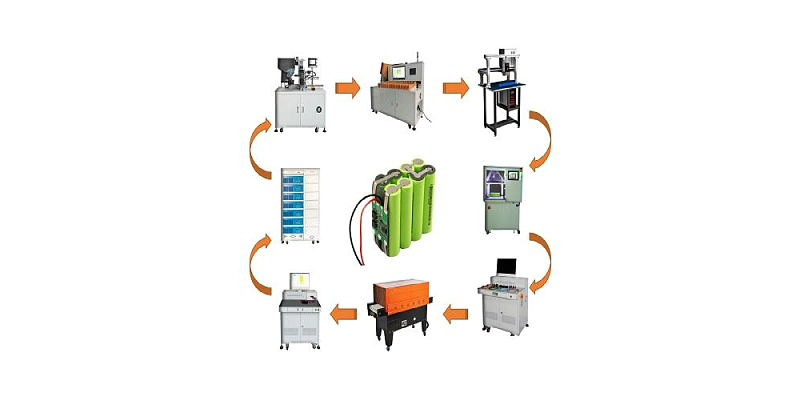
Why LiFePO4 Packs Are Built Differently: Inside the Assembly Line
LiFePO4 cells are chosen for stability, long cycle life and safety. Those same traits shape how the packs are built: the line looks familiar, but the details change at almost every station.
From Cell Sorting to Module Assembly
Incoming LiFePO4 cells are tested for capacity, internal resistance and voltage consistency, then sorted into matched groups. After cleaning, ultrasonic or laser welding joins them to busbars and insulation is applied. Because LiFePO4 cells are physically larger for the same capacity, module frames, cooling plates and mechanical spacing are sized differently.
BMS Settings and Pack Architecture
Chemistry also changes the control side. LiFePO4 packs work within different voltage windows, so the BMS is programmed and calibrated to a different charge profile, and cell balancing has to work against a flatter discharge curve. Modules are then housed in a protective enclosure with thermal management completing the build.
Testing, Traceability and Packaging
Each assembled pack runs through charge-discharge cycles, voltage checks, insulation resistance tests and load verification. Serialization keeps units traceable, and labels carry model, date and safety information before packaging.
Where UFO-POWER Stands
UFO-POWER has 25 years of professional technical expertise in the R&D and manufacturing of full-scenario energy storage and drone batteries. Matched cells, chemistry-specific BMS calibration and fully tested packs are the baseline for our LiFePO4 energy storage systems and battery packs.